Who Fishes in Portugal? Locals, Expats, and Tourists at the Water’s Edge
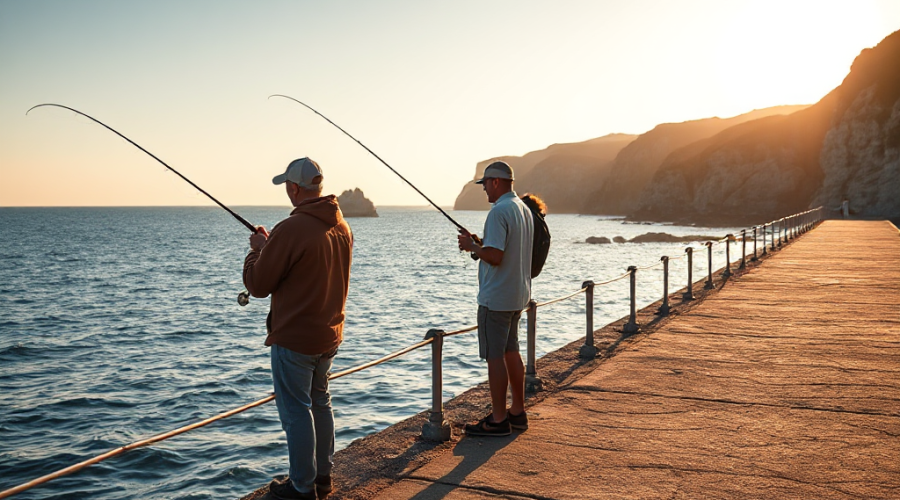
At first light on a pier near Cascais, three anglers stand within a few metres of each other, and they could not be more different. One is a retired Lisbon resident who has fished this stretch since childhood and knows exactly where the mackerel run. One is a British expat who moved to the Algarve two years ago and is still learning the rhythm of the Atlantic. One is a German tourist who booked a week by the coast, packed a travel rod, and has no idea whether the rules apply to a visitor. They all cast into the same water. They do not all face the same paperwork reality.
That pier is a useful way to understand the recreational fishing scene in Portugal, because the country’s coastline is not one market. It is three overlapping ones: residents who fish as a lifelong habit, foreign residents who fish as an adopted lifestyle, and visitors who fish as a holiday activity. Each group approaches the sport differently, and each group tends to discover the licensing side of fishing in portugal at a different moment, sometimes calmly and sometimes in a panic the night before a trip.
The Local Angler: Habit, Knowledge, and Quiet Routine
Portuguese recreational anglers are the backbone of the scene. They fish from rocks, piers, beaches, and small boats, often with gear that has been refined over decades. Their knowledge is local and specific: which tide pushes baitfish toward a particular headland, which month brings the first sea bass, which stretch of sand produces nothing after heavy rain. This is not information you find in a brochure. It is inherited and earned.
For this group, licensing is rarely dramatic. Many have held a licence for years and renew it as part of a seasonal routine, the way a driver renews insurance. They are also the least likely to be surprised by the rules, because the rules have been part of their fishing life for as long as they can remember. A mainland recreational sea fishing licence is administered under the DGRM framework, and local anglers generally understand which waters it covers, what gear restrictions apply, and when a boat-based trip needs something different from a shore session.
What has changed for this group is convenience. In the past, sorting out a licence could mean a trip to an office, a queue, and a form filled out by hand. Today, many residents handle it online in a few minutes, often from a phone, and get back to the more important business of checking knots and bait. The paperwork has become background noise rather than a hurdle.
The Expat Angler: Enthusiasm, Research, and the Learning Curve
Expats and long-stay foreign residents make up the fastest-changing segment of the market. They arrive with fishing experience from the UK, the Netherlands, France, or further afield, and they bring strong opinions about rods, reels, and rigs. What they usually lack is local context. The Atlantic off Portugal behaves differently from the North Sea or the Mediterranean, and the species mix is unfamiliar at first.
Their licensing journey tends to be more deliberate. Expats often research the rules before they even unpack, because they are used to a permit culture in their home country and assume, correctly, that Portugal has one too. They compare options, read forums, and ask in local tackle shops. The friction point is rarely the concept of a licence. It is the practical question of how to obtain one without a Portuguese tax number, a government portal login, or a working knowledge of Portuguese bureaucracy.
This is where the market has adapted. Online application services now let an expat complete a recreational sea fishing licence request in about three minutes, without a NIF and without navigating a government website, paying by card, Apple Pay, or Google Pay. For someone still learning the language and the systems, that is a meaningful reduction in friction. It turns a potential afternoon of confusion into a task finished over morning coffee.
The Tourist Angler: Spontaneity, Short Trips, and Last-Minute Decisions
Tourists are the most volatile segment. They decide to fish for all sorts of reasons: a charter booked on impulse, a quiet afternoon at a harbour, a child who wants to try casting from a beach. Their fishing window is short, often a few days, and their planning horizon is even shorter. Many do not think about a licence until they are already on the coast, rod in hand, looking at the water.
This group is also the most likely to misunderstand the rules. A tourist may assume that a short holiday session needs no permit, or that a permit bought at home covers them abroad, or that fishing from a pier is somehow exempt. None of those assumptions reliably hold. Mainland Portugal requires a recreational sea fishing licence for the activities it covers, and visitors are not outside the system simply because they are visitors.
The good news for tourists is that the process has become genuinely fast. A fishing license can be arranged online in a few minutes, which fits the way tourists actually operate: late at night, on a phone, after the decision to fish has already been made. The service is built for exactly this scenario, accepting common payment methods and removing the need for a government portal account or a Portuguese tax number. For a visitor with a flight home in four days, that speed matters more than almost anything else.
Where the Three Groups Overlap: Shared Waters, Shared Rules
Despite their different starting points, the three groups converge on the same coastline and the same core obligations. The sea does not distinguish between a resident and a tourist, and neither does the licensing framework. Anyone fishing in the waters it covers is expected to hold the appropriate licence, follow gear and catch rules, and respect seasonal and species restrictions.
That shared reality creates an interesting market dynamic. Locals often act as informal gatekeepers of knowledge, explaining local customs to newcomers. Expats sit in the middle, translating between the two worlds and often becoming the most vocal online voices on practical questions. Tourists arrive, fish, and leave, but their numbers are large enough that their needs shape how services are designed.
What all three groups increasingly have in common is a preference for digital handling of the administrative side. Nobody, regardless of nationality or residency, wants to spend a precious fishing morning chasing paperwork. The shift toward online applications has flattened the experience: a Lisbon retiree, a Lagos-based expat, and a visitor from Munich can all complete the same task in roughly the same amount of time, from the same kind of device.
It is worth noting what this does not change. A licence is not a guarantee of fish, and it does not replace local knowledge about tides, safety, or restricted zones. It is a permission, not a strategy. The anglers who do best are still the ones who combine the legal basics with patience and observation, whatever their passport says.
The Market Takeaway: One Coastline, Three Paperwork Journeys
If you step back and look at portugal fishing as a market rather than a pastime, the segmentation is clear. Locals treat licensing as routine maintenance. Expats treat it as a research project that should be simple and is now becoming so. Tourists treat it as a last-minute errand that must not derail a holiday. The product that serves all three is the same: a fast, clear, online route to the required licence, without unnecessary bureaucracy.
The pier at dawn will still hold three very different anglers tomorrow. The retiree will already be sorted. The expat will have checked the rules the week before. The tourist will be quietly grateful that the whole thing took three minutes on a phone. And the fish, as ever, will not care who is holding the rod, only whether the bait is in the right place at the right time.